
This is Part 1 of an ongoing series. We'll add to it throughout budget season.
Cliff Notes
Your Atlantic Beach city budget is a $57.6 million annual plan that decides how well your streets get paved, how fast a cop arrives, whether the park restrooms get renovated, and whether stormwater drains before it floods your yard. Every year, elected officials make hard tradeoffs — and you can weigh in before those decisions are final.
Budget workshops are open to the public. The FY2027 process is underway now, with workshops on July 20 and August 19 at 6 PM, Commission Chambers (or watch live at coab.us/live).
Five Things Every AB Resident Should Know
1. Atlantic Beach controls only about 15 cents of your property tax dollar.
The rest goes to Duval County/Jacksonville, public schools, and special districts. When you're frustrated by your overall tax bill, most of that bill isn't the City's to change.
2. Rising home values don't automatically mean more City revenue.
Florida's "Save Our Homes" law caps how fast assessed values can grow (more on this below). Longtime homeowners' property values can skyrocket on paper without generating a single extra dollar for the City.
3. The City isn't one big pot of money.
There are multiple funds — General Fund, Water & Sewer, Stormwater, Sanitation, Capital Projects, and more. Most can only be spent on specific things. Property taxes fund the General Fund; your water bill funds the Utility Fund. They don't mix.
4. Deferred maintenance is never free.
Every $1 the City skips in routine maintenance historically costs about $4 to fix later. "Saving money" by delaying road repairs or building upkeep creates a larger bill down the road.
5. The budget is a values document, not just a spreadsheet.
It reflects what the community is willing to pay for and what it's willing to let slide. Your voice matters most before the Commission votes — not after.
How Your Property Tax Bill Actually Works
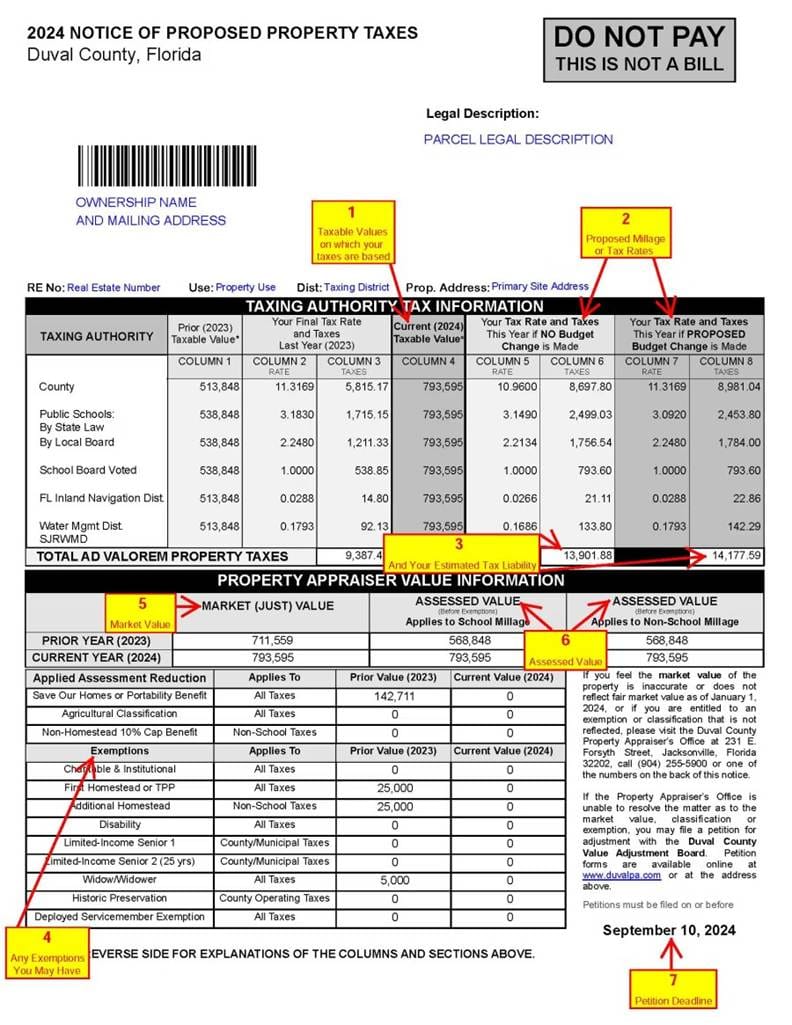
When you open your tax bill, you see one total — but it's actually five separate charges from five different taxing authorities. Below are two examples.
Sample 2024 Truth in Millage (TRIM) Notice
Real 2025 Atlantic Beach Property Tax Example (Home purchased in 1996)
|
Taxing District |
Mill Rate |
Assessed Value |
Exemptions |
Taxable Value |
Tax Amount |
% of Tax Bill |
|
Duval County / Jacksonville (County roads,
library, jail) |
7.9012 |
$279,890.00 |
$50,722.00 |
$229,168.00 |
$1,810.70 |
44.11% |
|
Water Mgmt Dist. SJRWMD (Regional water
resources) |
0.1793 |
$279,890.00 |
$50,722.00 |
$229,168.00 |
$41.09 |
1.00% |
|
FL Inland Navigation Dist. (Waterway
maintenance) |
0.0270 |
$279,890.00 |
$50,722.00 |
$229,168.00 |
$6.19 |
0.15% |
|
City of Atlantic Beach (Police, fire, parks,
roads, City Hall) |
2.7499 |
$279,890.00 |
$50,722.00 |
$229,168.00 |
$630.19 |
15.35% |
|
Duval County School Board (K-12 public
education) |
6.343 |
|
|
|
|
|
|
Public Schools:
Required Local Effort by State Law (Classroom instruction, teacher
salaries, regular student services) |
3.095 |
$279,890.00 |
$25,000.00 |
$254,890.00 |
$788.88 |
19.22% |
|
Local Capital
Improvement (Physical infrastructure: constructing schools, building
renovations, structural maintenance, technology equipment, and purchasing
school buses) |
1.5 |
$279,890.00 |
$25,000.00 |
$254,890.00 |
$382.34 |
9.31% |
|
By Local Board -
Non-Voted Discretionary Operating & Capital Outlay (Flexible revenue:
covers operational deficits, extra educational materials, and auxiliary board
expenses) |
0.748 |
$279,890.00 |
$25,000.00 |
$254,890.00 |
$190.66 |
4.64% |
|
School Board Voted -
Voted Operating Referendum (Teacher salaries, arts & athletic programs,
& proportional funding to charter schools) |
1 |
$279,890.00 |
$25,000.00 |
$254,890.00 |
$254.89 |
6.21% |
|
Totals |
17.2004 |
|
|
|
$4,104.94 |
100.00% |
What's a "mill"? One mill = $1 of tax per $1,000 of taxable value. At 17.2 mills total, a home with $300,000 in taxable value pays $5,160/year in property taxes — of which Atlantic Beach receives about $825.
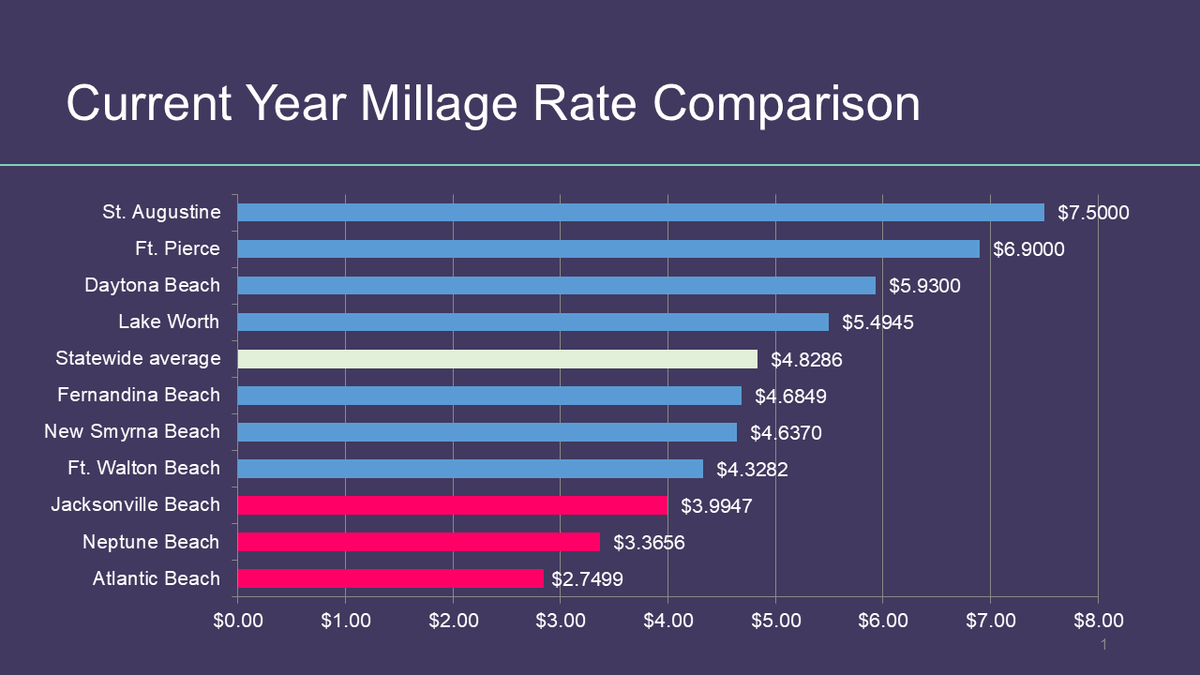
Atlantic Beach's 2.7499-mill rate is the lowest among Beaches cities — lower than Neptune Beach, Jacksonville Beach, and Ponte Vedra Beach.
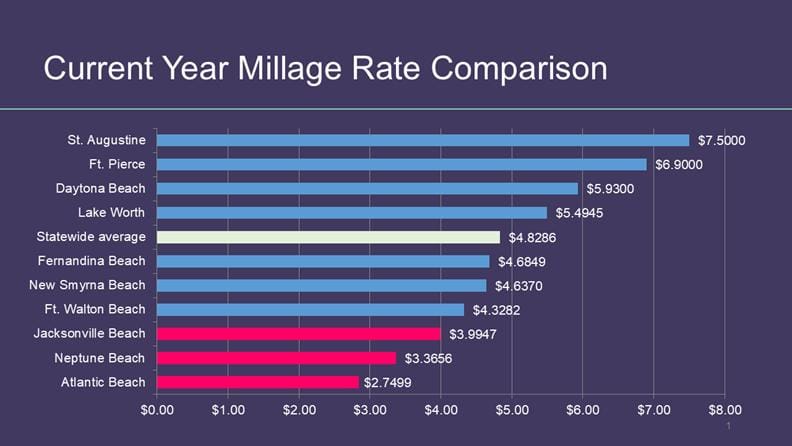
Source: Beaches Watch February 2026 Presentation
Why Your Tax Bill Is Lower Than Your Home's Market Value
This surprises nearly every new homeowner. Three things reduce your taxable value before any tax is calculated:
Step 1 — Save Our Homes Cap
Once you file for homestead exemption, your assessed value can only increase by 3% per year or CPI (whichever is lower), no matter how fast the market rises. In a hot market, this creates a growing gap between what your home is worth and what you're taxed on.
Example: Buy a home in 2015 for $300,000. By 2025, with 3%/year increases, your assessed value is ~$403,000 — even if the market says your home is worth $600,000. You're paying taxes on $403,000, not $600,000. That $197,000 difference is your "SOH benefit."
⚠️ The Recapture Trap: If the market drops, your assessed value doesn't automatically drop too. The assessed value must keep climbing by up to 3%/year until it catches back up to market value. Your tax bill can go up even while your home's market value goes down.
Step 2 — Homestead Exemption
Florida law removes up to $50,000 from your assessed value before calculating most taxes:
· First $25,000 applies to all taxing authorities (including schools)
· Second $25,000 applies to everything except schools
Step 3 — The Math
(Assessed Value − Exemptions) × Millage Rate ÷ 1,000 = City Tax Bill
For a home with a $403,000 assessed value:
· Minus $50,000 homestead = $353,000 taxable value
· Multiply by 2.7499 mills = $970,714.70
· Divide by 1000 = $970.72/yr to the City of Atlantic Beach
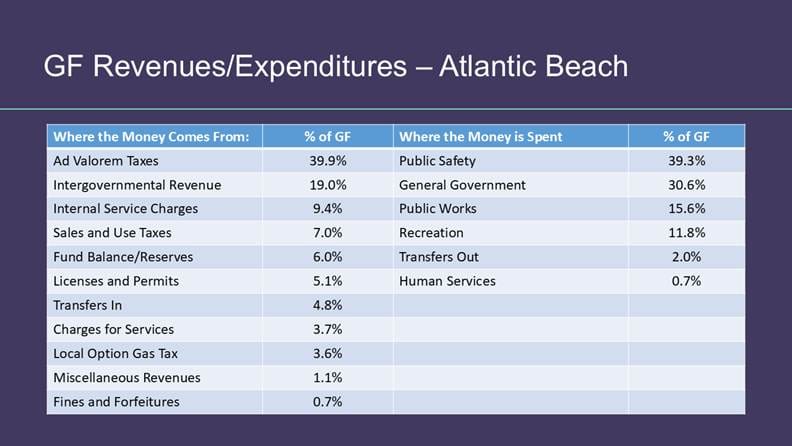
Where the Money Comes From (General Fund)
The General Fund is the City's main operating account and is funded by:
|
Revenue Type |
% of GF |
Source |
|
Ad Valorem (Property) Taxes |
39.90% |
Every property owner's share |
|
Intergovernmental Revenue |
19.00% |
State/county shared taxes & grants |
|
Internal Service Charges |
9.40% |
Utility & other funds paying City for shared admin |
|
Sales & Use Taxes |
7.00% |
Public service tax on electric/phone bills + tourist tax |
|
Fund Balance / Reserves |
6.00% |
Drawing from prior-year savings |
|
Licenses & Permits |
5.10% |
Building permits, business licenses |
|
Transfers In |
4.80% |
Other City funds contributing to GF |
|
Charges for Services |
3.70% |
Rec program fees, parking, etc. |
|
Local Option Gas Tax |
3.60% |
Fuel tax — restricted to roads only |
|
Miscellaneous |
1.10% |
Tower leases, surplus equipment sales |
|
Fines & Forfeitures |
0.70% |
Code enforcement fines, traffic citations |
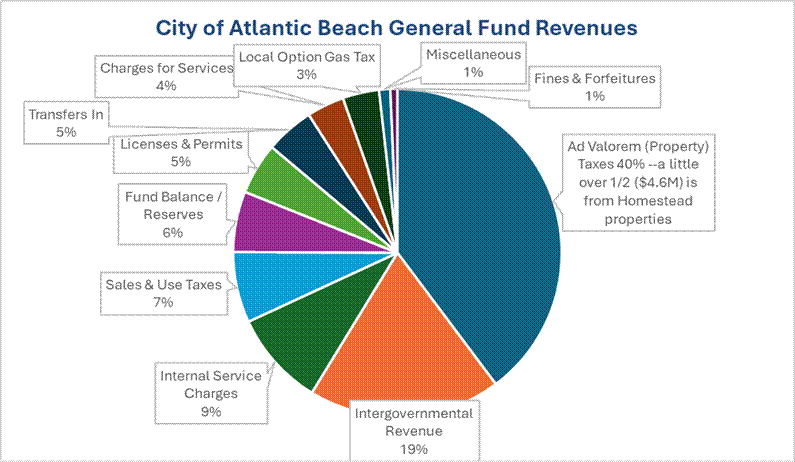
Key insight: When property markets spike, the City doesn't get a windfall. Save Our Homes shields most long-term homeowners' assessed values from rising at market speed. New owners (who reset to full market value) and non-homestead properties (rentals, commercial) contribute the most new revenue in a hot market.
Where the Money Goes (General Fund)
Source: Beaches Watch February 2026 Presentation
|
Category |
% of GF |
What's Included |
|
🚔 Public Safety |
39.30% |
Police, Fire/EMS contract with Jacksonville, Animal Control,
Code Enforcement, Lifeguards, 911 Dispatch |
|
🏛️ General Government |
30.60% |
City Manager, Finance, IT, HR, Clerk, Attorney, Planning/Zoning,
citywide insurance & overhead |
|
🚧 Public Works |
15.60% |
Roads, sidewalks, street lights, fleet, building maintenance |
|
🌳 Recreation |
11.80% |
Parks, splash pad, Tideviews & Dutton Island Preserves,
Adele Grage Cultural Center, rec programs & events |
|
↔️ Transfers Out |
2.00% |
Moved to Capital Projects, Debt Service, and other funds |
|
❤️ Human Services |
0.70% |
Grants to agencies like Sulzbacher and Beaches Emergency
Assistance Ministry |
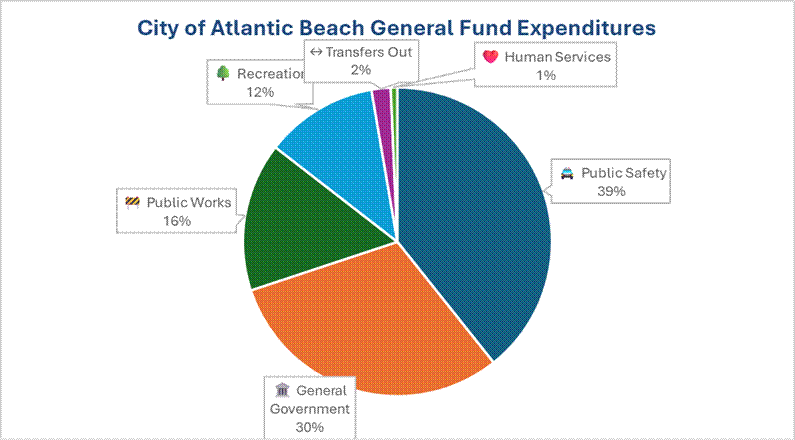
Note: "General Government at 30.6% isn't overhead bloat — it includes Finance (billing, payroll, grants), IT (cybersecurity, all City systems), HR, the Chartered Employees (City Manager, Clerk, Attorney, and Commission), and all departments and staff besides Public Works. Administration enables every other service to function.
Beyond the General Fund
The General Fund is only ~38% of the total city budget. The other 62% operates through dedicated enterprise funds largely self-funded by user fees:
|
Fund |
Funded By |
|
Water & Sewer (Utility) |
Water/sewer bills |
|
Stormwater |
Monthly stormwater fee |
|
Sanitation |
Trash collection fees |
|
Building Code Enforcement |
Permit & inspection fees |
These funds don't mix with General Fund tax dollars. When you pay your water bill, that money fixes water pipes — not police salaries.
Capital Improvements: The City's Long-Term Savings/Investment Plan
The operating budget covers day-to-day expenses. The Capital Improvement Program (CIP) covers major, long-lasting investments — typically $20,000 or more — that serve the community for years or decades.
Currently planned over 10 years:
· Public Works: $43.5 million in road, drainage, and infrastructure projects
· Neighborhoods/Parks: $4.45 million in park renovations and trail connections
Coming soon to your neighborhood:
· Ahern Street multiuse path (East Coast Greenway to Sherry Drive)
· Town Center street light replacement
· Donner Park LED lighting + new picnic shelters
· Marsh Oaks Community Center rehabilitation
· Russell Park skateboard park refurbishment
How CIPs are funded (not from property taxes alone):
· Half-Cent Sales Tax (Better Jacksonville Plan)
· Local Option Gas Tax — restricted to transportation
· State & federal grants
· Capital Projects Fund reserves
· General Fund transfers
⚠️ The BJP expires in 2030. Atlantic Beach currently receives about $1 million per year from this voter-approved sales tax. Losing it will create a real gap in the capital budget — a major topic for the next several budget cycles.
How the Budget Is Made: The Annual Calendar
|
When |
What Happens |
|
Oct–Mar |
Departments submit budget requests for next year |
|
Apr–Jun |
City Manager builds proposed balanced budget |
|
July 1 |
Property Appraiser
certifies taxable values — City now knows its tax revenue |
|
By Aug 5 |
Commission sets tentative millage rate (triggers TRIM process) |
|
By Aug 25 |
TRIM notices mailed to
every property owner showing proposed tax bills |
|
Jul–Aug |
Budget workshops (open to public) |
|
September |
Two required public hearings before final vote |
|
Sept 30 |
Final budget and millage
rate adopted |
|
Oct 1 |
New fiscal year begins |
How to Participate
The FY2027 budget process is live now. Future Budget Workshops are scheduled for July 20 & August 19, 6 PM in Commission Chambers.
· Attend or watch workshops: coab.us/live
· Read the current budget: coab.us/94/Annual-Operating-Budget
· Read the FY2025 financial audit: City WebLink
· Email/call with questions: [email protected] / (904) 247-5804
· Watch your mailbox: TRIM notices arrive before August 25
YOUR VOICE MATTERS especially before the Commission votes. Read the the City’s current budget and 2024-2025 financial audit, make public comment about what tradeoffs you are willing — or not willing — to make, ask questions via email to [email protected] or calling (904) 247-5804.
If you remember only one thing: Atlantic Beach’s budget is not just something that happens and it is not just a spreadsheet — it is the City’s annual decision about what kind of community we are willing to pay for.
Coming in Part 2: The millage rollback debate — what was saved, what was cut, and what it means long-term. Plus: the homestead property tax referendum and what it could mean for Atlantic Beach's finances.
Sources: City of Atlantic Beach FY2026 Adopted Budget; FY2024–2025 Annual Financial Report (audited); Florida Statutes §§ 166.241, 193.155, 200.065; Beaches Watch February & June 2026 Presentations, and City Manager’s June 29, 2026 Budget Workshop Presentation.

Member discussion: